
In the fast-paced world of digital marketing, flying blind is not an option. Whether you are a SaaS founder trying to capture market share, a blogger seeking higher ad revenue, or a local service business looking for more calls, understanding your competitive landscape is crucial. This is where competitor website traffic analysis comes into play.
By analyzing how users find and interact with your competitors’ websites, you uncover a goldmine of competitive intelligence. You can discover hidden keyword opportunities, identify content gaps, map out referral sources, and understand audience behavior. Most importantly, you gain the data needed to build a smarter, more effective website growth strategy.
However, a crucial caveat exists: third-party SEO tools provide estimates, not exact analytics data. You cannot see a competitor’s private Google Analytics dashboard. Instead, you use advanced algorithms and clickstream data to approximate their performance. When used correctly, these estimates are incredibly powerful for benchmarking and strategic planning.
This comprehensive guide will walk you through the essential steps to conduct a thorough competitor traffic analysis, turning raw data into actionable insights for your SEO strategy and content marketing performance.
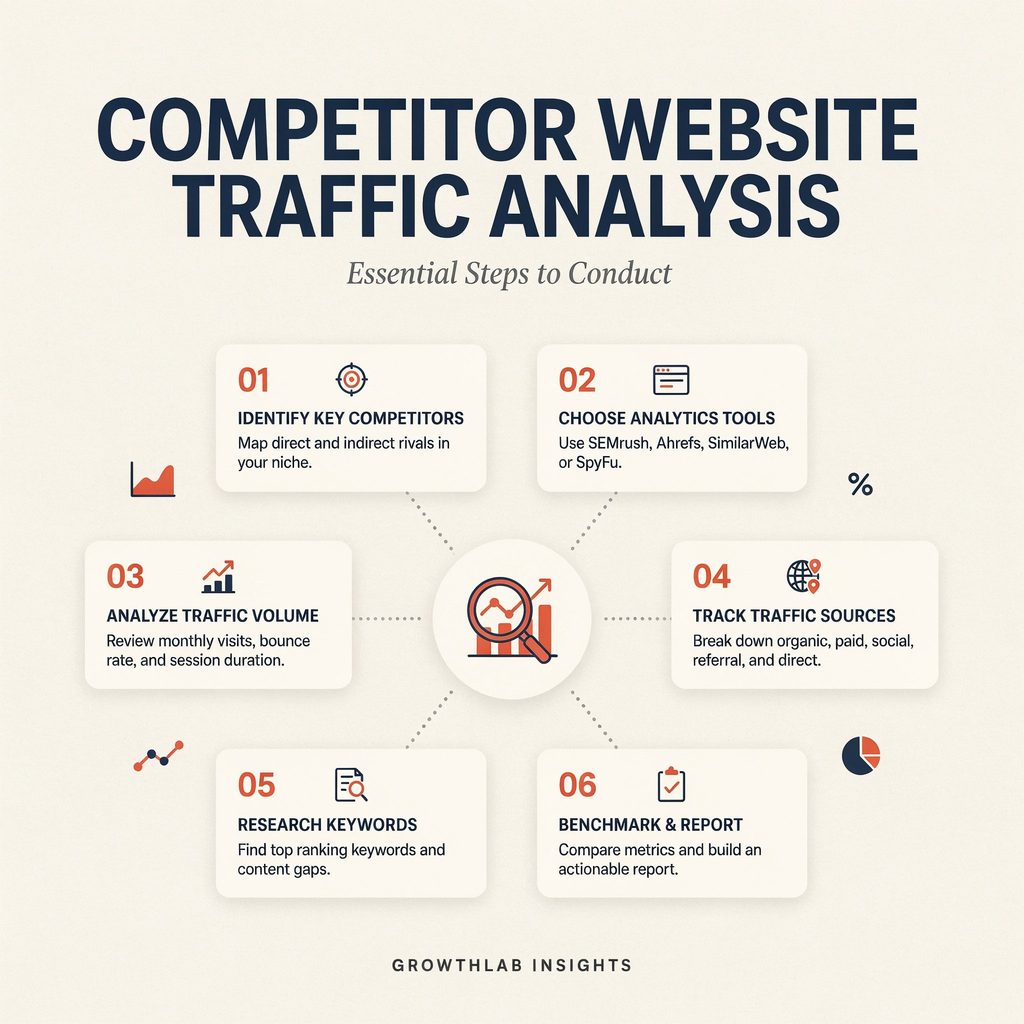
What Is Competitor Website Traffic Analysis?
Competitor website traffic analysis is the process of evaluating the volume, sources, and behavior of visitors arriving at a rival’s website. Using specialized website traffic checker tools and competitive intelligence platforms, marketers can reverse-engineer a competitor’s digital success.
A comprehensive analysis reveals a wide array of data points, including:
- Estimated monthly website visits: The total volume of users hitting the site.
- Organic search traffic: Visitors arriving via unpaid search engine results.
- Paid traffic: Visitors clicking on PPC ads.
- Referral traffic: Users clicking links from other websites.
- Direct traffic: Users typing the URL directly or using bookmarks.
- Social media traffic: Visits originating from social networks.
- Top-performing content: The specific pages driving the most visits.
- Audience geography: Where in the world the visitors are located.
- Device usage: The split between desktop, mobile, and tablet users.
- Engagement metrics: Bounce rates, pages per visit, and average visit duration.
- Traffic trends over time: Historical growth, seasonality, and sudden spikes.
Direct vs. SEO Competitors
It is vital to distinguish between a direct business competitor and an SEO/content competitor. A direct competitor sells the same product or service to your target audience. An SEO competitor, however, might not sell anything at all but competes for the same search engine real estate. For example, if you sell project management software (SaaS), your direct competitor is another software company. Your SEO competitor might be a productivity blog that ranks #1 for “best ways to manage remote teams,” stealing top-of-funnel traffic away from your product pages.
Why Competitor Traffic Analysis Matters
Conducting online competitor research is not about copying; it is about finding efficiencies in your own digital marketing research. By analyzing web traffic sources and user behavior, you unlock several core business benefits:
- Finding high-value organic keywords: Discover the exact phrases buyers use before making a purchase.
- Discovering content topics: See which blog posts or guides attract the most visitors.
- Identifying strongest channels: Learn if your rivals rely heavily on organic search, paid ads, or social media.
- Spotting backlink opportunities: Find out which authoritative sites are linking to your competitors.
- Understanding seasonality: Notice when traffic spikes so you can time your campaigns perfectly.
- Improving PPC targeting: See which paid keywords and ad copy your rivals are bidding on.
- Benchmarking website growth: Establish realistic marketing benchmarks for your own KPIs.
- Finding content gaps: Identify questions your audience is asking that your competitors have failed to answer.
Example in Action:
Imagine a home-maintenance blog noticing a rival’s massive traffic spike in October. By digging into the data, they discover the competitor ranks highly for “how to winterize outdoor pipes.” Armed with this insight, the blog can proactively publish a comprehensive guide, complete with a video tutorial, in early September to capture that seasonal search engine traffic before the freeze hits.
Identify the Right Competitors
Before pulling data, you must build a targeted competitor list. Relying only on your obvious business rivals will leave massive blind spots in your SEO competitor analysis.
Types of Competitors to Track
- Direct Competitors: Businesses offering the same products or services (e.g., two local plumbing companies).
- Search Competitors: Sites that rank on page one for your target keywords, regardless of their business model.
- Content Competitors: Publishers, magazines, or niche blogs covering your industry topics.
- SERP Competitors: Sites occupying valuable Search Engine Results Page (SERP) features like featured snippets, local map packs, or “People Also Ask” boxes.
- Paid-Search Competitors: Brands consistently outbidding you on Google Ads.
- Industry Publishers: Major media sites or directories that dominate your niche’s information space.
How to Find Them
Start by typing your core products or services into Google. Note the domains that appear in the organic results and the sponsored ad slots. Use keyword research tools to see who ranks for your secondary terms. Check social media searches, industry marketplaces (like G2 for SaaS or Etsy for e-commerce), local directories, and even ask your customers: “What other websites or brands did you look at before choosing us?”
Choose Competitor Analysis Tools
You cannot conduct accurate traffic source analysis without the right software. Because no single tool has a perfect view of the entire internet, using a combination of platforms helps validate estimates.
- Semrush & Ahrefs: The industry heavyweights. Excellent for deep organic keyword research, backlink gap analysis, and robust traffic estimation based on massive clickstream databases.
- Similarweb: Highly regarded for audience insights, traffic acquisition channels, and referral traffic analysis. It excels at showing the “big picture” of a brand’s digital footprint.
- SpyFu: A specialized tool highly effective for paid search competitor analysis and PPC competitor research.
- Moz & SE Ranking: Great alternatives for tracking Google rankings, domain authority, and core SEO metrics.
- Ubersuggest: A beginner-friendly, budget-conscious option for basic website traffic estimation and keyword suggestions.
- Google Trends & Google Keyword Planner: Free tools essential for validating search volume and macro-level industry trends.
- Google Search Console: While only for your first-party website performance data, it is essential for comparing your actual metrics against competitor estimates.
Pro Tip: Cross-reference data. If Semrush estimates a competitor gets 50,000 monthly visits and Similarweb estimates 48,000, you can be highly confident in that benchmark.
Analyze Overall Website Traffic
Once your tools are set up, start with a high-level overview of your competitors’ estimated monthly visits. However, do not stop at the headline number. Total traffic can be misleading; a site might have millions of visits but terrible conversion optimization.
Instead, focus on interpreting traffic patterns:
- Traffic Growth or Decline: Is their audience expanding month-over-month, or did a recent Google algorithm update penalize them?
- Historical Traffic Data: Look at a 12-to-24-month timeline to identify steady growth versus viral, short-lived spikes.
- Geographic Location: Are they capturing your target local market, or is their traffic coming from countries you do not service?
- Desktop vs. Mobile: If 80% of their traffic is mobile, but their site isn’t optimized for it, you have a UX opportunity to outperform them.
- Engagement Indicators: Look at pages per visit, average visit duration, and bounce rate. High traffic with a 95% bounce rate indicates clickbait or poor search intent matching.
Examine Traffic Channels
Understanding how visitors arrive is just as important as knowing how many arrive. Break down their web traffic sources to see where they are investing their marketing budget.
Organic Search Traffic
This is the holy grail of sustainable digital marketing. High organic traffic indicates strong domain authority, excellent content performance analysis, and good technical SEO. If a competitor dominates here, analyze their content gap and target their keywords.
Paid Search Traffic
A high percentage of paid traffic suggests the competitor is aggressively buying market share or testing new offers. It indicates high commercial intent but also high customer acquisition costs.
Direct Traffic
Strong direct traffic implies excellent brand awareness. Users are typing the URL directly because they trust the brand. E-commerce stores and established SaaS companies often see high direct traffic from returning customers.
Referral Traffic
This reveals their PR and partnership strategies. Are they getting mentioned in major industry publications? Are they featured on resource pages? Referral traffic is a strong indicator of off-page SEO health.
Social Media Traffic
Look at which platforms drive their visits. A B2B SaaS company might get high-value traffic from LinkedIn, while a niche gardening blog might rely heavily on Pinterest.
Email and Display Traffic
While harder to track perfectly via third-party tools, sudden spikes in overall traffic that don’t align with search or social trends often point to successful email newsletter blasts or display advertising campaigns.
Find Competitors’ Top Organic Keywords
Competitor keyword research is the engine of your organic growth strategy. You want to find the terms that drive qualified buyers to their site, not just random scrollers.
Types of Keywords to Target
- High-Intent Commercial Keywords: Phrases like “best CRM for small business” or “buy leather work boots online.” These drive conversions.
- Informational Keywords: “How to fix a leaky faucet.” These build top-of-funnel awareness and trust.
- Long-Tail Keywords: Longer, highly specific phrases with lower search volume but much higher conversion rates and lower keyword difficulty.
- Branded Keywords: Searches for the competitor’s name. You generally cannot rank for these, but monitoring their volume tells you how strong their brand awareness is.
The Filtering Process
Do not just export a list of 10,000 keywords. Filter the report by Search Volume (is it worth targeting?), Keyword Difficulty (can my site realistically rank for it?), and Search Intent (does the user want to buy, learn, or navigate?).
Look specifically for keyword gaps—valuable keywords that multiple competitors rank for, but your website currently does not. These represent immediate content opportunities.
Analyze Top Pages and Content Performance
Traffic rarely distributes evenly across a website. Usually, 20% of the pages drive 80% of the traffic. Use your competitor analysis tools to identify their top-performing pages and reverse-engineer their success.
Evaluate the formats they use:
- Blog Posts and Guides: Are they writing 3,000-word ultimate guides or quick 500-word tips?
- Product and Category Pages: How do they structure their e-commerce categories for SEO?
- Tools and Calculators: SaaS companies and finance blogs often generate massive backlinks and traffic via free interactive tools (e.g., a mortgage calculator or ROI estimator).
- Templates and Resources: Downloadable assets are incredible lead magnets.
- Comparison Articles: “Product A vs. Product B” pages capture high-intent buyers right before checkout.
When reviewing these pages, analyze their search intent alignment, content depth, use of headings, internal linking structure, visual assets, and calls to action (CTAs). Note their publishing freshness; do they update old posts annually to maintain rankings?
Review Backlinks and Referral Traffic
Backlinks remain a foundational pillar of Google rankings. A backlink gap analysis shows you which authoritative sites are endorsing your competitors but not you.
Focus on referring domains (the number of unique websites linking to them) rather than just total backlinks. One link from a major industry publisher is worth more than 100 links from low-quality directories.
Link-Building Opportunities to Look For:
- Linkable Assets: Did they publish an original industry study or infographic that everyone is citing? Create a better, more updated version.
- Guest-Posting Opportunities: See which industry blogs accept guest posts by looking at their author bios and outbound links.
- Resource-Page Links: Find educational pages linking to your competitors and pitch your own superior resource.
- Digital PR Mentions: Are they getting quoted in news articles? Use platforms like HARO (Help a Reporter Out) to get your own founders quoted.
- Broken-Link-Building: Use tools to find broken outbound links on authoritative sites that point to dead competitor pages, then suggest your live page as a replacement.
Always prioritize link quality, relevance, and contextual placement over simply chasing a high number of backlinks.
Investigate Paid Search and Advertising Strategy
Even if you rely primarily on SEO, analyzing a competitor’s paid search strategy provides incredible insights into their messaging and offers. Tools like Semrush and SpyFu allow you to view historical PPC competitor research.
- Paid Keywords: What terms are they willing to spend actual money on? These are usually your highest-converting keywords.
- Search Ad Copy: Analyze their headlines and descriptions. What pain points are they highlighting? What emotional triggers are they using?
- Landing Pages: Click their ads (or view the cached versions) to see their landing page design, form lengths, and conversion optimization tactics.
- Offers and Discounts: Are they pushing a “20% off” sale or a “Free 14-Day Trial”?
- Display and Shopping Ads: For e-commerce brands, analyze their Google Shopping feeds and visual display banners to see how they position their products visually.
Ethical Note: Always conduct ethical competitive research. Analyze public information, ad transparency libraries (like the Meta Ad Library), and SERP results. Never attempt to access private analytics accounts, confidential data, or restricted advertising information.
Analyze Social Media and Audience Engagement
Social media traffic is a vital piece of the digital marketing competitor analysis puzzle. It tells you how a brand builds community and distributes its content.
Evaluate their presence across relevant platforms:
- LinkedIn: Crucial for B2B SaaS and professional services. Look at thought leadership posts and employee advocacy.
- Facebook & Instagram: Key for e-commerce, local businesses, and lifestyle bloggers. Note their use of Reels, Stories, and user-generated content.
- TikTok & YouTube: Video content dominates modern search intent. Are they creating short-form tutorials or long-form reviews?
- Pinterest: A visual search engine essential for niches like home decor, recipes, and DIY.
- X (Twitter): Good for real-time customer service, tech news, and industry discourse.
Look beyond vanity metrics like follower counts. Assess their posting frequency, content formats, engagement rates, and influencer partnerships. More importantly, track how effectively they drive links from these platforms back to their website. High engagement means little if it doesn’t translate to website visits and leads.
Create a Competitor Traffic Analysis Spreadsheet
Data is useless if it isn’t organized. To maintain a clear marketing benchmark, build a central dashboard to track your findings. A simple spreadsheet updated monthly or quarterly will help you monitor trends and spot shifts in the market.
Here is a practical framework for your competitive intelligence tracker:
| Competitor | Estimated Monthly Traffic | Organic Traffic | Paid Traffic | Top Channel | Top Keywords | Top Pages | Referring Domains | Main Social Platform | Key Opportunity |
|---|---|---|---|---|---|---|---|---|---|
| Competitor A | 125,000 | 90,000 | 20,000 | Organic | “best project management tool” | Pricing Page, “Agile Guide” | 1,450 | Create a better Agile guide | |
| Competitor B | 45,000 | 15,000 | 25,000 | Paid | “cheap task tracker” | Homepage, Features | 320 | Target their branded keywords | |
| Competitor C (Blog) | 210,000 | 195,000 | 0 | Organic | “how to manage remote teams” | “Remote Work Stats 2025” | 3,100 | Pitch original data study to publishers |
Use this table to compare your own metrics side-by-side with your rivals, ensuring your website growth strategy remains data-driven.
Turn Insights Into an Action Plan
Research without execution is just entertainment. Once you have gathered your data, translate it into a prioritized action plan.
8-Step Action Plan
- Target keyword gaps with high business relevance and attainable keyword difficulty.
- Improve or create content around proven topics, ensuring your piece is more comprehensive and up-to-date.
- Strengthen internal linking to pass authority to your newly created priority pages.
- Build backlinks to your new linkable assets using the outreach strategies discovered in your research.
- Test high-intent paid keywords that your competitors are profiting from.
- Improve weak traffic channels (e.g., if they dominate Pinterest and you are absent, start pinning your blog graphics).
- Create better conversion paths and calls to action based on their landing page analysis.
- Track changes and refine the strategy monthly.
30-Day Competitor Analysis Workflow
- Week 1: Discovery & Tool Setup. Identify 3-5 core competitors. Run them through Semrush/Ahrefs/Similarweb and populate your tracking spreadsheet.
- Week 2: Keyword & Content Audit. Perform a keyword gap analysis. Select 5 high-value content pieces to create or update based on competitor top pages.
- Week 3: Off-Page & Link Outreach. Analyze competitor backlinks. Build a list of 50 prospects for guest posting, resource page inclusions, or digital PR pitches.
- Week 4: Paid & Social Review. Audit their ad copy and social formats. Launch a small A/B test on your own PPC campaigns or social media strategy based on their winning formulas.
Common Mistakes to Avoid
As you dive into traffic acquisition channels and SERP analysis, avoid these common pitfalls:
- Treating estimates as exact numbers: Remember that tools provide modeled estimates. Use them for directional trends and benchmarking, not absolute financial truth.
- Copying instead of differentiating: Your goal is to learn from their strategy, not plagiarize their content. Add your unique expertise, brand voice, and original data.
- Focusing only on high-volume keywords: High volume often means high competition and low intent. Do not ignore low-volume, high-converting long-tail keywords.
- Ignoring search intent: Ranking for a keyword is useless if your content format (e.g., a product page) doesn’t match what the user wants (e.g., an informational guide).
- Neglecting conversion quality: A competitor might have massive traffic but a terrible conversion rate. Focus on traffic quality and user experience.
- Overlooking smaller competitors: Niche players often have highly optimized, agile strategies that larger, slower companies miss.
- Failing to consider seasonality: Do not panic if your traffic drops in December while a competitor’s spikes; they might be in the retail gifting niche.
- Making decisions based on one tool alone: Always cross-reference data points to ensure accuracy.
Frequently Asked Questions
How can I check a competitor’s website traffic?
You can check a competitor’s traffic by entering their domain URL into competitive intelligence tools like Semrush, Ahrefs, or Similarweb. These platforms use vast databases of clickstream data, search engine rankings, and ISP data to model and estimate a website’s monthly visits, traffic sources, and audience demographics.
Are competitor traffic estimates accurate?
Competitor traffic estimates are highly directional but not 100% exact. Because third-party tools cannot access a site’s private Google Analytics, they use mathematical modeling. The estimates are generally accurate enough to identify trends, compare market share, and benchmark growth, but they should not be treated as precise financial data.
What is the best tool for competitor website traffic analysis?
There is no single “best” tool, as it depends on your needs. Semrush and Ahrefs are widely considered the best all-in-one suites for deep SEO, keyword, and backlink analysis. Similarweb is often preferred for high-level traffic source breakdowns and audience insights. SpyFu is highly recommended specifically for PPC and paid search competitor research.
How often should I analyze competitor traffic?
For most businesses, a deep-dive competitor analysis should be conducted quarterly. However, you should perform lightweight monitoring—such as checking keyword rankings and top-performing pages—on a monthly basis. This allows you to stay agile and react quickly to new content campaigns or algorithm updates.
Can I see a competitor’s Google Analytics data?
No. Google Analytics is a private, first-party tracking code installed on a website’s backend. Unless a competitor voluntarily shares their dashboard or publishes a public case study, you cannot see their exact bounce rates, session durations, or conversion tracking. You must rely on third-party estimation tools.
What should I do after identifying competitor keyword gaps?
Once you identify a keyword gap (keywords your competitors rank for, but you do not), evaluate the search intent and business value of those terms. Prioritize the ones that align with your products or services. Then, create high-quality, comprehensive content optimized for those specific keywords, and build internal and external links to help the new pages rank.
Conclusion
Conducting a competitor website traffic analysis is one of the highest-ROI activities a digital marketer, SaaS founder, or small business owner can undertake. It removes the guesswork from your SEO strategy, highlights exactly what your target audience is searching for, and reveals the exact pathways your rivals are using to capture market share.
By systematically evaluating traffic channels, uncovering content gaps, and analyzing backlink profiles, you transition from reacting to the market to proactively shaping your digital presence. Remember to use the data as a strategic compass, not a rulebook, and always prioritize delivering unique value to your users.
Your Call to Action: Don’t let this data sit idle. Pick one direct or search competitor today, plug their URL into a traffic checker tool, and identify three keyword gaps or top-performing pages. Commit to drafting one piece of superior content based on those findings this week. Your future traffic growth starts with that single step.